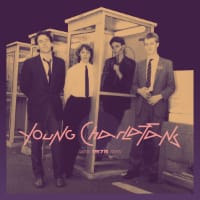
 1978 - Young Charlatans (Eminent Vinyl)
If you go on YouTube you can see a remarkable clip of two 18-year-old kids, Rowland S Howard and Ollie Olsen, being interviewed by the ABC. As the teenagers walk down St Kilda Road in Melbourne, they are jeered at for looking like aliens with art school aesthetics.
It was 1978 and a vastly different time in Australia. In the beige, conservative world ruled by the Tories and the Country Party. Every second house had porcelain ducks on its wall and a framed picture of Queen Elizabeth the 2nd. The Robert Menzies vision of Australia ruled and the fashion mindset embraced Dennis Lillee’s porn star moustache and safari suits.
The Melbourne music scene reflected that - with a few exceptions. It was mostly all blues and pub rock. Australians like old music. And most were still stuck in Sunbury, circa 1973. The Saints and Radio Birdman had toured the city and left a mark. There was an explosion in their wake. Just like the handful of kids who saw the Sex Pistols at Manchester's Free Trade Hall at the end of 1976, many of the people who where in the audience for Birdman and the Saints went on to form their own bands.
Menzies' disciples could not stop cultural change. Rowland and Ollie, with their eyeliner and and op-shop clothes, must have looked to them like dandies who'd crossed the sensibilities of Oscar Wilde with English anarchic fashion. Looking back, they were The Men Who Fell to Earth.
What was less well known was that they were both writing some of the most cutting edge post punk music anywhere in the world. Rowland S Howard had already penned “Shivers” a couple years of earlier and had demonstrated a touch of genius.
As author Clinton Walker correctly states, at the beginning of 1978 there were only two bands looking forward: The Young Charlatans and the Boys Next Door. I would add Garry Gray’s The Reals,
The Boys Next Door had a secret weapon in Tracy Pew’s primal, Stooges-inspired bass playing, while Nick Cave was then a charismatic pretty boy who sang falsetto. The band was basically new wave, and the darlings of St Kilda.
North across the Yarra River, The Young Charlatans found it hard to get gigs; they were so much more edgy and raw than their contemporaries and certainly more visionary. Cave went to many of their gigs and was in awe of Rowland’s songs and style.
The Young Charlatans' lifespan was less than eight months but their impact on the local scene cannot be underestimated.
Ollie and Rowland were 18-years-old when they shifted base to Sydney, occupying a squalid reented flat in Darlinghurst at the end of 1977. The only emergent local band that caught their fancy that had attitude and urgency in equal does was X - and they were truly dangerous.
The pair recruited Jeffery Wegener who was a couple of years older and already had a small degree of public profile as the first Saints drummer. He'd been a schoolfriend of Chris Bailey and Ed Kuepper in the erly ‘70s. As a player, Wegener was already ahead of the pack.
They teamed with New Zealander Janine Hall, another like-minded soul who played bass. The nascent band moved back to Melbourne in the New Year. The demos and raw live performances on this record are from the first month of 1978.
This is well-packaged document comprising eight raw demos and six live tracks. It opens with a blistering “Broken Hands” and there’s a wild urgency in this song, borne out of attitude and the freshness of youth. Some use that cliche of post punk, “angular”, to describe some music and maybe, in this case, it fits. It is brutal and feels like hitting speed humps.
“Beginning of a Real War” is a demo and ranks as one of the most intense pieces of music I have ever heard come out of Australia. It sounds like an early Birthday Party song - played with razor blades. You can almost see the blood smeared guitars.
“Drowned” moves into the Gothic sphere and is played with equal amounts of tension and intensity as the song’s demo recording breaks apart, distortion cutting through as the meters go into the red. Roland’s guitars are stunning and are the foundaiton of the vibe.
“Win/Lose” is blazing punk song; it has the intensity of the Dead Kennedys but but recorded at least 18 months before they were known in these parts. The songs that Ollie attacks are certainly more aggressive and brutal. He must have been existing on a very strong diet of the debut Clash album, and he captured Joe Strummer’s distorted vocal edge, probabky by almost swallowing the microphone. The song is so urgent.
“Shivers” is more ragged than the Boys Next Door’s version. Rowland’s vocals wail like early Bob Dylan. .The song is passionate and personal, imbued with the torture of first love. This is the version of the song that must be remembered for prosperity.
I once asked Rowland in a St Kilda coffee shop what he thought of The Screaming Jets' version of "Shivers". He said it was drivel but it paid the rent for a while. The thought of an incredibly sensitive, cutting-edge Australian classic now being sung on rock cruises to people with studded belt bellies and dragon tattoos (ie. middle age drunks) somehow irks me. This is a fragile letter of hurt that was written by a 16-year-old, a sensitive and creative teenager. To think of it being delivered in other contexts is quite surreal.
Side two opener “Model” the first of the live songs captured on primitive recording equipment; the sound is patchy and has tape hiss and distortion throughout. That said, the recording really fits the low-fi vibe of a band that was barely out of the garage in 1978.
“Seems So Distant” is the most startling song on the album. It’s full of tension and hints of Tom Verlaine’s guitar. It could have fitted perfectly on the Birthday Party’s debut album, and has that discordance that we hear on that band’s more refined songs of two years later, like “Catholic Skin”.
What's dawned on me is the complete impact Roland S Howard had on the Boys Next Door, the band he would join later in that year.
Listening to the live side of “1978”, we are served up garage punk on songs like “My Empire” and “Hello World” with their classic chanting vocals.
“Doll Maid” is a bona fide gem that closes the album; it almost has a Paul Weller edge before it flies away on a nasty tangent with clouds of discordance among the chaos.
The guitars are blazing and the interplay between Ollie Olsen and Roland S Howard is sensational, You can hear that Rowland was influenced by Brian James on one side and the melodic edge of Tom Verlaine and Richard Lloyd on the other. Ollie attacks the chords like Joe Strummer with brutality. And, again, it’s so intense.
Now to Jefferey Wegener and Janine Hall: Wegener’s drumming on these tracks shows all the signs of his genius and underlines why he became an integral member of Laughing Clowns a few years later.
By 1980, he was possibly the most creative drummer in the country. Mixing intense rhythms, time changes, and light and shade – all with Charlie Watts' coolness. Here, his playing is tough and occasionally ragged, but he has enoigh discipline to give the songs a solid backbone. He also hits the kit very hard. Janine, at this stage, is no frills, and lets the songs shine through. She clicks in tightly.
The Young Charlatans were a startling band compared to anything else in Australia (or even the UK) at the time They were cutting edge and had already moved to what was to be known as post-punk.
In 1978, Radio Birdman was a proto-punk band and appeared dated to English audiences (ED: Or at least to the UK press). The Young Charlatans were looking toward the future and could have been accepted by those same audiences. Their sound was modernist and well before its time. Only Pere Ubu could compare when “The Modern Dance” was released in February 1978.
Certainly, if The Younge Charlatans had stayed together and headed to England, they would have fitted in with the likes of Gang of Four, Magazine, The Slits and The Pop Group. They would had been at the head of that pack if they had stayed around. Then again, they would also have starved and been at the mercy of the pretentious and obnoxious English music press. Life is unfair.
This album of low-fi and at times poorly recorded demos and live performance needs to be evaluated in context. On its merits, it could be the greatest collection of post-punk songs ever put to tape in Australia. That it was recorded even before that phrase was a term of reference makes it a significant historical document. It is a time capsule of four very creative individuals who were breaking down boundaries at the beginning of 1978.
 And its own shrine in St Kilda