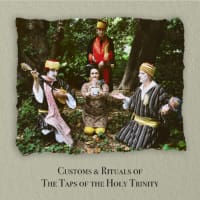
 Customs & Rituals Of... - The Taps of the Holy Trinity (Fenny Compton)
To me, the world is full of folks who think the letter of the law is more important than why the law was conceived, and why the letter of the law can and should be turfed if it's obvious, the reason for the law is being distorted. Same goes for guitar nerds and also those people who seem to think that dexterity and cleverness makes a great song. It fucking doesn't. Nor do all those sound alike bands on streaming networks.
Just because I love The New York Dolls no, it does not mean I love Aerosmith. Or the local pub equivalent. Because I love a particular band does not mean I will love the cover version.
I recently paid for, and saw, 17 minutes of Lydia Lunch's Suicide tribute - and left because I really wasn't enjoying it. In fact, I found the whole thing trite, lite, and boring. The actual band, at any point in its lopsided trajectory, wasvsimply a force of nature but this was like watching The Wiggles do a Suicide matinee (and, to be completely honest, as I was walking out I realised I probably would have enjoyed a Wiggles concert).
See, there's real, visceral human emotion in every Suicide LP, every Suicide recording. If you're now only vaguely remembering “Ghost Rider” or “Frankie Teardrop”, I suggest a re-set and get hold of their second LP, which should've been in the top ten in the US (instead The Cars who took them on a US tour only for the Septics bottled them off). And, I'm sure, in most of the bands you love it bulges out like yer half-a-teacake (don't bother looking this expression up. AI has no idea cos it doesn't know nuffink about slang).
Anyway, the humanity fairly drips out of The Taps of the Holy Trinity; the first song, “The Magus” opens the album and you'd be forgiven for thinking you'd put on a Morricone soundtrack by mistake. Perhaps the sequence where the bad guy sneaks up through the scrub to ambush the good guy in the bath, only to slip on a bar of soap, be clubbed to death and lie bleeding in the soapy water.
Er, possibly. band leader Australia’s Michael Plater may or may not be a familiar name to you; he's been troubadouring his way around the world for well over a decade now, and the impression he's making ... well, he's capturing the hearts of like-minded souls.
The Taps of the Holy Trinity are a new project from Plater and fellow experimental musicians Arthur Karanikas (BBQ Haque), Dee Hannan (George Xylouris Ensemble), Dave Bullock (Paul Kidney Experience, Kiss My Poodle’s Donkey) and Danny Martinov (The Exit Keys). The album also features contributions from Italian violinist Massimiliano Gallo and UK experimentalist Paul Rodgers.
So, no, you can't really dance to it in the usual way, though the second and fifth songs have a purely hypnotic Motorik beat to them. Someone stick this LP beneath the snout of Julian Cope. Like any decent record, you can be drawn in and captured by the music, and the tonalities of the vocals, and the background light and shade, and ... at the back of it, the lyrics which are extraordinarily evocative. On top of all this, it was mixed and mastered (with a bit more recording) at Creepy Hollow by Loki “Velatine” Lockwood.
Artur Mieczkowski of anxiousmagazine.pl writes:
The Taps of the Holy Trinity is a project born at the crossroads of different musical worlds, yet it quickly developed a language entirely of its own. Bringing together artists long associated with the experimental, psychedelic and improvised music scenes, the group draws inspiration from Greek folk music, Anatolian traditions and Balkan folklore. Rather than attempting to recreate these traditions, however, they transform them into a new musical narrative shaped by ritual, imagination and personal experience. Their album Customs & Rituals Of is neither an exercise in historical reconstruction nor an ethnographic document. Instead, it is a work where cultural memory merges with psychedelia, improvisation and experimentation, allowing tradition to become a living source of artistic exploration.
Which is better than I can put it when I have a gin hangover.
Actually, come to think of it, sod Julian Cope. Get this LP in front of director Christopher Nolan. “Taps” is the beginning of a script, dammit. Hell, any song which begins, "Out there in the wilderness/ Out there without a map/ A new world before you/ The old world at your back" is just hungry for a film to start ...
Since I don't want to take up too much of your time telling you what you should know by now (as in: go to Bandcamp and get yer credit card out), so I asked a few questions of the main magicians behind '”Taps”, Michael Plater and Arthur Karanikas..
* * * * *
I-94 Bar: Could I start with the band name, please - what ARE the taps of the Holy Trinity, ffs? We're not talking gold taps in baths and showers, I assume?
Michael Plater: No gold taps or golden showers references here, Robert, no! There was a lot of drawing on Greek history and folklore and traditions for the lyrics for the album, and this often involved Arthur sending me little news stories and scraps of information on Greek historical events. In one of these, the phrase “the taps of the holy trinity” grabbed my attention, referring to the water taps that were, historically, often placed outside churches and monasteries for physical and spiritual cleansing and purification. As the album explores themes of tradition and ritual, this seemed like an appropriate band-name.
Arthur Karanikas: Yes, the “taps” (βρύσες) or springs/running water, are things which you come across, say in public spaces, on the edge of roadside villages and in grounds of places of worship across Europe. In that context they seem to suggest something of catharsis or even a form of absolution.
I-94 Bar: Could you tell me about your own experiences with ghosts, and of mortality?
Michael Plater: Ghosts have always been a fascination of mine, perhaps to an unhealthy degree! It’s also been a lyrical motif – both literal and metaphorical - throughout my work (see my most recent solo album “Ghost Music” for evidence!) As for experiences, I’ve had a few ghostly encounters over the years. I remember sneaking into a supposedly haunted old carpark in Melbourne with my partner Fawnia late at night – it was a space that used to be an old Cobb and Co'coach station – and seeing a ghostly figure above me on a stairwell, that seemed to hover above the ground and whose legs seemed to dissolve into air. Whether that was a visual hallucination or not, who knows?
I should also mention that there was quite possibly a ghost present when we recorded the album as well! I was staying at Arthur’s place during the making of the album, and, on several nights, I was woken by loud knocking on my bedroom door. When I opened the door there was no-one there. The second night it happened, Arthur heard it as well.
Arthur told me that there’s a cemetery nearby and we don’t know if somehow or for some reason whatever it was may have made its way from there. Arthur’s sister and his mother eventually came to perform a homemade Greek blessing/exorcism to ward it off!
Arthur Karanikas: We're barely into question two Robert! I do remember being witness to a cleansing/washing ceremony of a deceased person's bones in my parent's village a long time ago which unsettled me for a short time.
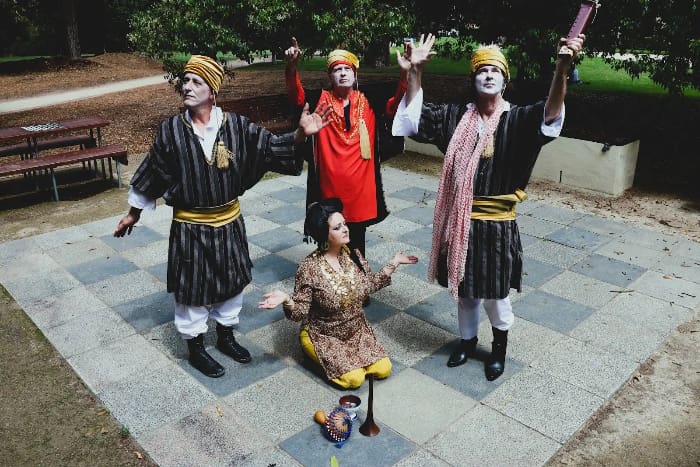 The Taps of the Holy Trinity in action. Artist supplied
I-94 Bar: Have you ever done the anastenaria, and if not, would you? What is it about the barefoot firewalk which captured your attention?
Michael Plater: I would be up for trying it, yes! I like the idea of the anastenaria as an ecstatic, trance-inducing ritual, where participants somehow dance across burning coals without injury. Of being in a state so far removed from the everyday that they are, in a sense, beyond pain. I also think it relates to our music, in that we were trying to tap into that sense of music as ritualistic trance state.
Arthur Karanikas: A Greek aunt took me to see it on a visit in '91. Devotional praying with ecstatic dancing in the shrine which goes on for hours and animal sacrifice along the way to the glowing embers in the evening. Apart from the firewalking, I think it was the intoxicating dance and drone of the instruments during the praying which remained with me. Was struggling to understand what I had seen the following day.
I-94 Bar: This is a question I would not ordinarily ask, however, your Taps of the Holy Trinity pretty much demands I do: are you a Christian, or a Syncretist?
Michael Plater: No, I’m not a Christian, even though I was nominally raised as one. I can appreciate some of the rituals and imagery involved though. I’m not a Syncretist either, even though I like hanging out at Buddhist temples (which I find to be very peaceful environments). My religious beliefs lean more towards the pagan, although I’ve never felt any need to formalise those beliefs or join any kind of religious groups, gatherings, cults, etc.
Arthur Karanikas: I was baptised in a Christian church. I remember early on as kids my sister and I both agreed ‘this place blows more than wog school, we're outta here!’ Things felt more uncomplicated after that, although mum believed we'd be inhabited by souls of sinners in some kind of temporary purgatory. Syncretist? Why are people always obsessed with developing something new all the time? We have Christianity!
I-94 Bar: Michael, the delivery of your lyrics has always struck me as very strong, as if they've been somehow soaked in a kind of permanent marinade to the point where they simply cannot avoided - the flavour is always going to be powerful, and cannot be washed away. That's a listener's perspective - what stages have you put your singing voice through?
Michael Plater: With this album, I wanted to find a new approach to singing, to stretch my voice into new areas and to sing in a different way. I think the sound of the music demanded it, and I was conscious of the fact that this wasn’t going to be a singer/songwriter album, and I didn’t want my voice to be front-and-centre all the time.
With Greek music, there’s often a lot of wailing, crying, and lamenting going on as well, so I wanted to try and do something that echoed those traditions. So there were lots of shouts and yelps and cries going on while we were recording. I even came up with my own language on "Slow Ghosts". I can’t speak Greek, so, with "Slow Ghosts" I improvised vaguely Mediterranean and East European-sounding words and phonetic phrases.
I-94 Bar: Both “Slow Ghosts” and “Most of Them Were Ghosts” have a strong Motorik beat wrapped in a glorious cacophony - how did these two songs come together?
Michael Plater: I’m going to have to admit that both of those tracks are essentially the same song! After we finished recording "Most of Them Were Ghosts'"Arthur happened to accidentally do a half-speed playback of it on the four-track reel-to-reel tape we were using. We loved how it sounded slowed-down, so we actually made a recording of it like that (with the assistance of the great Loki Lockwood) – hence “Slow Ghosts” – and then added new layers – my vocals, Danny Martinov’s drums, some more percussion from Dave Bullock – on top. As for “Most of Them Were Ghosts”, it’s essentially an electrified/psyched-up version of a traditional Greek dance rhythm; when Arthur played it for his elderly Greek mother she said “Ah! A belly-dance song!”
I-94 Bar: What was your first instrument, and do you still have it?
Michael Plater: I still have my first electric guitar – a Japanese Fender Strat. Although it’s rusted to buggery and doesn’t really work anymore. It’s currently sitting in a cupboard at my sister’s place in Wales.
Arthur Karanikas: It was a nylon acoustic borrowed from a cousin. I remember asking for it, but she was a bit sceptical about loaning it to me. She asked, “who you gonna be? The ugly Duran Duran?” Must have handed it back at some point.
I-94 Bar: What were the first bands or songs which really got your attention? Why? Has your taste in music changed the further you travelled on the musician's journey?
Michael Plater: Some early ones were The Velvet Underground, Bob Dylan, Violent Femmes, Public Image Ltd, The Smiths. The Velvet Underground were a huge one - the first song I managed to work out for myself on guitar was "Heroin". I loved the Velvets because their albums were unpolished and raw, lyrically brilliant, and their songs were quite simple to play – “Heroin” is just two chords.
I loved the aesthetics and mood as well, and Reed and Nico’s voices (I also love Nico’s solo albums). I’m into a lot of different things these days – English folk music, psych, electronica, Greek music, even prog (which my younger self would have run a mile from). I think it’s crucial for musicians to keep discovering new things, new sounds – to maintain that excitement of discovery. Once that stops happening, you atrophy.
Arthur Karanikas: I guess it was mostly things we were exposed to at the time really. Things you'd hear on the radio or something you may have seen on tv. I had seen Chad Morgan perform on the box on some variety program and didn't know what to make of this character with his out of shape teeth, but later understood that the content of his songs was something which felt surprisingly honest and real.
But I think it really started when The Models, with James Freud fronting them, did one of those high school gigs at our school in the early or mid-‘80s. I remember liking the support band more, which was a Pink Floyd covers band. It felt challenging to listen to. Other than that, probably KISS, The Stooges and The Velvet Underground's “Sister Ray” because the sound felt raw and immediate. It sounded dangerous like early rock 'n'r oll.
As for my taste in music changing – yes of course it has. I think it's innate in people to search for something new or different. Our grey matter constantly needs stimulation, otherwise you're going around in circles. I think I’ve sorta left western style music behind a bit these days. I mostly listen to things that are more ethnic based now, say from the Middle East, African music, the Balkans and the eastern Mediterranean. I find it easier to relate to because those cultures seem to be able to communicate the 'feel' of what it is to be alive.
I-94 Bar: What was the first music you heard which made you sit up and decide: I gotta make music?
Michael Plater: Again, the VU. I remember telling my family that I would be a musician when I was around 15, and their response was “but you can’t play anything!”; I had just started playing guitar (badly) at that point .
Arthur Karanikas: I think I heard the “Hawaii Five-O” theme on the TV and thought, "wow, what's this racket?" Television was a powerful medium back then. Plus we had done an assignment at school which involved going to a recording studio where the three of us had to interview the engineer. I won't tell you who it was, but I thought, this stuff doesn't look hard. Looks more about getting dressed up in leather pants!
I-94 Bar: The website I write for are old school Detroit-fanciers, so, for you in 2026: Iggy and the Stooges or the MC5? which LP?
Michael Plater: The Stooges, definitely. The MC5 never really clicked with me, I’ve got to say. “Raw Power” was the first LP I heard (I think I was around 12), and there’s always a special affection for “the first”, so I’ll go with that. There’s a dark power to songs like “I Need Somebody” and “Gimme Danger” that’s hard to beat. (ED Pun intended?)
I-94 Bar: But, come on. Stooges or Velvets? Or should I not make you choose?
Michael Plater: It’s got to be the VU, for the previous stated reasons!
I-94 Bar: There are a whole pile of musical reflections and refractions going on in your music - what do you listen to when you're travelling together?
Michael Plater: During the recording of the album, it’s mainly been old Greek music, appropriately enough, alongside some psych, Afro beat, prog, and folk stuff. Some current mutual favourites:
- Various: “Aman Aman” (Greek Anatolian Laments)
- Markos Vamvakaris: “Death is Bitter”
- Erkin Koray: “Elektronik Türküler”
- Les Rallizes Denudes: “The Oz Tapes”
- Various: “Greece is…Folklore”
- Anestis Delias: “1912-1944”
- Orchestre Abass: “De Bassari Togo”
I-94 Bar: What do you most enjoy about touring?
Michael Plater: One of my favourite writers, Colin Wilson, often spoke of how, when we escape from the routine and the everyday, when we are in new environments and experiencing new things, there’s a kind of rush of consciousness, and the world suddenly feels more alive, more vital. That’s how I feel about touring!
I-94 Bar: What's your favourite on-stage rig?
Michael Plater: For an electric guitar, nothing beats the combination of putting a Fender guitar into a Fender amp. These days, I also like to play with a little “digital Tambura” drone box, after trying out my friend Adam Geoffrey Cole’s (of Trappist Afterland).
I-94 Bar: Favourite guitar?
Michael Plater: Of late, my favourite guitar has been a beat-up 'Dorado' acoustic 12-string that my sister picked it up for me for 10 quid when she was working at a charity shop in Bristol. It sounds beautiful, although the bastard never stays in tune, and restringing it is a nightmare that involves lots of blood and swearing!
I-94 Bar: Fave pedal/s?
Michael Plater: My favourite pedal these days is my Fender Space Delay. You can hear it on “The Taps of the Holy Trinity” track “The Passage” – lots of random shuddering noises, trills, and clangs, and there’s a great noise from it (at the 9.15 to 9.25 mark) that sounds like the spirit leaving the body.
I-94 Bar: If you had the means to play a gig anywhere and anywhen, where would it be? And, who with?
Michael Plater: I’m returning to Europe later this year to play Greece, England, Spain, Sweden, France with lots of old friends/bandmates including Massimiliano Gallo, Tasos Koromilas, Jaime Oliveira, Tim Williams, Roger Dalyrymple etc – that’s as good as it gets for me!
I-94 Bar: Five most wicked gigs you've ever seen?
Michael Plater: Leonard Cohen, Diamanda Galas, Swans, Warren Zevon, Rowland S. Howard
I-94 Bar: Five Australian bands you dig?
Michael Plater: Crime and the City Solution, Dead Can Dance, Trappist Afterland, Matt Malone & The Holy Spirits, Fabels
Arthur Karanikas: Grong Grong, Lubricated Goat, The Scientists, Coloured Stone, The Go-Betweens 1/2
1/2