
- Details
- By Robert Brokenmouth
- Hits: 5741
LOST MY HEAD FOR DRINK - Bloodloss (Dirty Knobby/SubPop)
Fourteen years old by now, "Lost My Head for Drink" sounds both ahead of its time and retro, and has an elusive timeless quality. Who else puts out such a fabulous mixture of mellow tunes and stifling ferocity? Rock discovered parallel with caustic, free-flying jazz? This version of Bloodloss is its own genre. Simple as that.
No? Look, you know that famous American painting Nighthawks at the Diner? Well, this LP is like that, but more real, more gritty, less smooth but a lot more emotional and substantially more fucking elegant. Ennui and boredom be buggered, in "Lost My Head for Drink", Bloodloss have a classic LP.
- Details
- By The Barman
- Hits: 4945

If Alive Naturalsound putting out a live album of their current roster sounds indulgent, then so be it. LA-based French expat Patrick Boissel's label has built a stunning back catalogue that presaged and launched today's back-to-basics garage blues-soul scene, harking backwards but always looking forwards.
- Details
- By Pepsi Sheen
- Hits: 5675
RENT PARTY - The Waldos (Jungle Records)
I ain't owned that beautiful Nina Antonia book about Johnny Thunders for years-poor people can't have nice things - ya always have to sell it all to eat and smoke. "Everything is in the pawnshop", you dig? But all those swanky Heartbreakers photographs are etched forever in my mind.
- Details
- By The Barman
- Hits: 5534
 This is bass-heavy punk rock from Sydney with an initial "we're-drinking-cans-at-the-football-on-the-hill-so-sing-along-with-us" flavour. This is five, short and sharp songs with names like "No Logo Is A Joke" and "You Want It" so you might suspect that it's all politically incorrect. Of course, first impressions are often wrong. It's punk rock with a left-of-centre social bent.
Super Best Friends (wasn't that a South Park episoide?) have already had the Triple Jay thumbs-up - but don't hold that against them. They knock around with Children Collide and Violent Soho so it's going to work as punk rock for the generation that can't remember last Friday night, let alone the Sex Pistols.
Guitarist Johnny Barrington sings in a broader-than-Sydney-Heads accent without sounding like he's bunging it on( like those worse than awful Australian hip hop acts.) Matt Roberts' bass sound hand playing s more pliable than the GDP of a small West African country and Adam Bridges' fluid drumming kicks things along nicely.
There's a lot of crunch in the guitars and a whole bunch of shouting. Blips of sythn run through "Karma Karma" so it's not just rote punk. The songs are catchy with choruses and drop-outs. All in all, perfect festival fodder. I can hear the kids at the next Splendour In The Grass singing away to "You Want It" or the scathingly anti-xenophobic "The Bleachers."
Fast, furious and fun - and a step above most of the latest wave of what passes for punk rock, Super Best Friends might lyrically fly over the heads of some the people who pick up on them but that's not going to stop anyone having a good time. - The Barman
 1/2
- Details
- By The Barman
- Hits: 4875
 Here's French garage rock from five guys who have soaked up a fair bit of the output of The Lyres, at a guess. I caught them in the flesh a couple of years ago, supporting a reformed Screaming Tribesmen in France's best rock and roll tavern, Mondo Bizzaro in Rennes, and this four-track 10-inch EP sounds like they do live.
- Details
- By The Barman
- Hits: 991
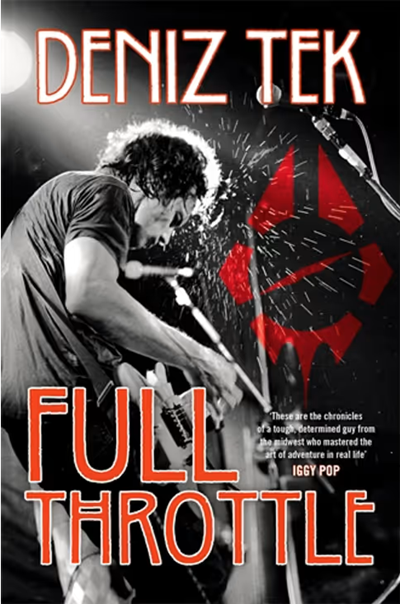 Full Throttle
By Deniz Tek
Picador-Pan Macmillan Australia
Deniz Tek’s autobiographical “Full Throttle” hits the bookshelves at a time when “Retaliate First”, the newest and most detailed story of his most storied band, Radio Birdman, hasn’t yet made it to the remainder bins at Big W. It joins photographer George Munoz’s lavish coffee table effort, “When The Birdmen Flew”, and Chris Masuak’s “Faith and Practice in Bedlam” which are still available in stores.
Vivien Johnston's thesis in a biography's dust jacket, "Radio Birdman", was long regarded as the defintive history but is years out-of-print and fetches big bucks on eBay. And while Your ABC still won’t screen “Descent Into The Maelstrom” - still the best rock documentary made in this country despite being disowned by two former band members - it can be streamed on Apple TV or Prime.
So it’s a crowded dancefloor on which to do The Moving Change.
Tek has taken a different tack to most of those that have gone before. Rather than fixate on Birdman, “Full Throttle” tracks through its author’s time in military aviation and emergency medicine and casts a light on his solo bands and side projects. Appearances by the Birdmen are pre-flight or involve the final line-up and are fleeting. There’s no aggro and any contestable turf or uncomfortable issues are avoided.
The first review of this book to appear online had an issue with "Full Throttle" lacking a coherent narrative. That critque was written by a Nick Cave fan who once described bands that sprang up in Birdman's wake as "oafish".
On balance it probably does help if you know the Radio Birdman back story, but there’s enough meat on this book’s bones to maintain a casual fan's interest. The comment that there isn't enough self-reflection might carry weight, but there's also some surprisingly generous commentary about a former guitar partner who was integral to the Tek comeback album, "Take It To The Vertical".
- Details
- By JD Misfortune
- Hits: 1100
 Not That Way Anymore
By Frank Secich
(High Voltage Publishing)
Circumstantial Evidence
By Frank Secich
(High Voltage Publishing)
So my good friends, I'm having some medical problems that are slowing down my productivity in every area of my life; I don’t get around much like I used to. So sorry I'm late, all my brothers and sisters and friends of the Revolution, but here in the shadows of balls-out, flock camera, no-due-process concentration camps, evisceration of the Fourth Amendment, torture gulags where underage immigrant girls are being impregnated by the homegrown masked Gestapo, tech Fascism and WW 3 - and pretty much everything Lords Of The New Church and The Wanderers spent all their most vital life force trying to warn us about, so it could all be avoided - is coming to life all around us.
- Details
- By Edwin Garland
- Hits: 1190
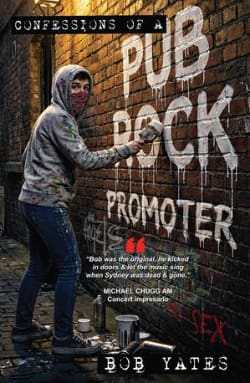 Confessions of a Pub Rock Promoter
By Bob Yates
Peach Tree Press
Not every half-baked musician, rock manager, pseudo academic or person who has dipped their toe into the entertainment industry can write a music book. The output often makes good doorstops. Music writing is an art of its own. Not everyone can write a song, either, but that’s another story.
That said, we do have some great writers in this country with an ability to capture a vibe. The best have a vibrancy to their work and an ability to translate exciting moments.
Some memoirs make an emotional connection or show a deep understanding of a moment in time. Overseas, Suzi Rotolo’s book on the early NY folk scene and her relationship with Bob Dylan springs to mind. Locally, the darkly cynical work of Bob Short and his musical journey, or Jim Moginie’s autobiography, are examples.
When an author is able to combine all of the above, you have gold.
Bob Yates manages this, both with his candid story of his deep love and regret about the loss of his dutiful and talented partner Virginia, and his journeys through the Australian music industry.
The book opens with a vista of the the beige world of Australia in the 1950s and ‘60s. A world of Menzies, portraits of Queen Elizabeth, and blokes who wore long socks and shorts. Like many kids, Bob’s world changed suddenly with the arrival of The Beatles, the Rolling Stones and Dylan and then war in Vietnam.
Bob and Virginia were a young couple building a home and a life together. Bob’s story about the loss of his marriage while deeply involved in music carries a sense of regret and ultimately humility.
Sydney kid Bob Yates had already proven to have that entrepreneurial spirit; the local paper boy who mowed lawns for a few shillings with his sleeves rolled up. In his teens, he was playing the stock market and made heaps of money - enough to pay half the deposit for house in Balmain. He then lost a small fortune and was in heavily in debt.
The character of a hard-edged promoter was shaped at early age, along with an ability to climb out of a hole. Bob was back waking up at 5am to start work again, putting in enormous hours in factory work, mowing lawns or as a cleaner.
Yates fell into the world of booking, and promoting gigs from his early 20s. It was completely street level, handing out flyers, doing poster runs and hiring halls. He held packed events at Balmain and Paddington Town Halls, as well as in assorted community and church halls, and some of his gigs drew almost a thousand people.
Bob’s book provides insights of a scene that I knew little about. In the late ‘60s and early ‘70s, Balmain was a hub of Sydney culture. “Confessions of a Rock Promoter” shines a light on acts like Jeannie Lewis and Captain Matchbox as well as the lesser known ones - including Ward and Johnston, the duothat Bob managed, That he ended getting major international supports for them like Ike and Tina Turner provides an understanding of the wheeling and dealing involved. Bob Yates was certainly a mover and shaker for close to a decade.
It was towards the end 1976 that Bob sensed a change in Australia. The impact of Radio Birdman on Sydney has been well documented. It was not only the music. Doors were now open to a variety of new music and new venues were springing up – especially iun their home town Sydney.
The legendary underground spot, French’s Tavern on Oxford Street, was changing its booking policy and opening a rock room downstairs. A band with a fervent following on the city’s northside had recently changed its name from FARM to Midnight Oil, and was dropping its prog rock pretentions with a nod to Radio Birdman’s twin guitar attack. Birdman’s impact was equally evident on The Angels who were evolving out of being a roots boogie band from Adelaide into something more theatrical and calculated.
Bob Yates’ story of Midnight Oil auditioning for the Stage Door Tavern where he was now the booker is hilarious – especially with the arrival of the fast talking and intense Garry Morris as their manager. Bob booked the Civic Hotel in Goulburn Street and by 1978 it was a bastion of a new breed of bands, hosting the art students from Mental as Anything and early gigs by The Angels and Cold Chisel.
It was here that the early postpunk scene emerged into the light and it was full houses most nights. You can feel the energy of that time in Bob’s writing. Rooms like The Civic gave a home to arty indie bands and allowed them to be creative. Punk venues were also opening in the rundown parts of the city near Central Station and were drawing mostly underage kids. It was, as Yates relates, a real changing of the guard.
The book explodes as Ian Rilen makes his entry into its pages. Bob Yates perfectly captures the man’s spirit and charisma – the wildness and raw talent.
Ian’s formation of X had really made an impact on Sydney. A tough, street level bass player with a grounding in bands like Fraternity, Band of Light and the early Rose Tattoo, Ian left that latter band with “Bad Boy for Love” before departing because he thought they were heading in the wrong direction. Now he had a new beast.
Unlike Midnight Oil, who were allocated a Tuesday audition, Bob gave X their first Civic gig on a Friday night on reputation alone - and for a huge guarantee. The line-up down Pitt Street was full of a new breed of inner-city audience with a red “X” painted or stencilled onto ripped jeans and tee-shirts. X drew a full house, leaving scars on the carpet and broken glasses as far as the eye could see. Yet they were welcome back as they broke the bar record.
A couple of years later, Ian wanted Bob to manage his stunning new band Sardine V. Yates, had a fair a bit to do with Ian securing a publishing deal. Ian was certainly one of the most talented songwriters to have emerged on the scene.
Bob’s description of the inner-city music scene of punk and post punk is raw and exciting. Yates was well over a decade older than most of the musicians on stage and even older than an audience mostly aged in their teens. His background was a decade in folk music and roots bands. He describes the sudden shift as a massive tidal wave with words conveying the rawness and passion of the music itself. These bands he cites are names many of us know; Laughing Clowns, Lipstick Killers, Hitman, Ward 13, The Passengers, Jimmy and Boys, Flowers and The Professors among them, just to name a few.
Bob was now booker and promoter of The Civic, Stage Door and the Royal Antler on the Northern Beaches that was the Oils were packing out. A pivotal point for Bob was the arrival in 1978 of Mi-Sex from New Zealand, following a well-worn path trod by Dragon and the La De Das. Suddenly, they were the new band to check out. Yates was impressed.
A large section of book is focused on him taking them from a midweek, $50 a gig support band to being the biggest pop drawcard in Australia. It is tale of a gigantic rise to the top, built on belief, bravado and bold, sharp managements skills by a man who became workaholic. Sweeping up all the awards of 1980 and dealing with the American arm of CBS Records, the small-time Sydney promoter of a few years earlier found himself working with the biggest names in the industry and walking into the boardroom of a record monolith in New York City.
These are heartbreaking aspects to this. CBS were dickheads and it’s a body-blow to Bob when they don’t keep their word. There is a lot of fast talking. And the next thing can be another conversation and another line of coke. It’s a fascinating story and a warning to those who romanticised the industry without saying what really goes down.
Sadly, in world of inflated egos is a lack of understanding that what goes up can fall very quickly. Bob realises this is not his world and decides he wants out. He seen enough of where he does not want to be.
Bob’s final major foray into the big time was a Tiny Tim show, presented with artist Martin Sharpe at The Sydney Opera House. It’s a tale set in the twilight zone where art and street level promotion were never meant to meet.
Here we are in 2026 and the industry is completely changed and has lost its sense of alternative, counterculture. Private colleges have diplomas in music management and it’s a world away from the tough side of dealing with underworld figures with pistols in backroom offices drawers, bundles of cash in car boots, and amphetamine-fuelled roadies driving 3000 kilometres to get a band’s gear to a gig on time. A world with no Instagram, Facebook or band websites.
“Confessions of a Pub Rock Promoter” is a rip-roaring read by a gifted writer and a window into a time many decades ago.

- Details
- By The Barman
- Hits: 1132
 Spirits Of The Hoey. A Love Letter To The Hopetoun Hotel
By Liz Giuffre and Gregory Ferris
Images by Bryan Cook
Melbourne Books
By The Barman
Love letters aren’t meant to be literary works; they’re words from the heart. That’s as apt as any descriptor for “Spirits Of The Hoey”, a 208-page softcover ode to a Sydney pub that closed its doors 16 years ago.
Every city should have a Hoey. Back in the ‘80s and ‘90s, Sydney had a few of them. I was always more of an Excelsior person, but The Hoey had something that it and other pubs lacked (maybe with the eventual exception of The Sando at Newtown) and that was a clientele that regarded it as a second home.
Back then, cheap rents and plentiful run-down inner-city housing meant the Sydney underground musical scene’s nexus was a handful of postcodes spanning Darlinghurst, Surry Hills and maybe Paddington.
You could have thrown a blanket over them (preferably black - as someone sonce said, it wasn't a colour but a way of life.) The Hoey was “the local” for many musicians in the scene. It may not have been Ground Zero for the city's underground rock but you could see it from there.
Subcategories
Behind the fridge
Artifacts and reviews from days gone by.
Send us stuff to review
PO Box 334
Oatley NSW
2223 Australia
Get in touch: barman@i94bar.com
The Living Eye

New Christs
NOV
21 - The Brightside, Brisbane, QLD
+ Suicide Country Hour
+ Mick Medew & The Ursula 4
Joeys Coop
NOV
29 - Junk Bar, Brisbane, QLD (arvo)
DEC
10 - Burdekin Hotel, Sydney
supporting The Crystal Set
w/ Allanah Russack
The Exploding Universe of Ed Kuepper
Ed Kuepper 50 Years Retrospective
RESCHEDULED
NOV
13 - Fremantle, Freo Social, WA
15 - Brisbane, Princess Theatre, QLD
Tickets
Reverend Horton Heat (US)
Australian Tour
NOV
12 - The Gov, Adelaide, SA
+ The Satellites
13 - Factory Theatre, Sydney, NSW
+ The Johnnys + Pat Capocci
14 - Croxton Bandroom, Melbourne, VIC
+ The Johnnys
+ Ezra Lee & Jumpin' Jethro
15 - Theatre Royal, Castlemaine, VIC
+ The Johnnys
Hoodoo Gurus
"Rewind Tour - All Killer, No Filler"
+ Ratcat + The Stems
NOV
28 - Hindley Street Music Hall, Adelaide, SA
DEC
1 - Ice Cream Factory, Perth, WA
5 - Tumbalong Park, Sydney, NSW
6 - Royal Botanic Gardens, Melbourne, VIC
11 - Fortitude Music Hall, Brisbane, QLD
16 - Odeon Theatre, Hobart, TAS
The Saints 73-78
UK Tour with The Damned
NOV
25 - Brighton, Dome
27 - London, British Airways ARC
28 - Bristol, Beacon
30 - Manchester, Academy
DEC
1 - Newcastle, O2 City Hall
2 - Derby, Vaillant Live Derby
5 - Birmingham, O2 Academy
The Saints 73-78
Australian Tour
JAN
21 - Newcastle, King St
+ Chimers
22 - Sydney, Metro
+ Antenna
23 - Wollongong, Waves
+ The New Christs
29 - Brisbane, Tivoli
+ Tape / Off
30 - Gold Coast, Miami Marketta
+ Mick Medew & The Ursula 4
FEB
2 - Perth, Astor
+ Last Quokka
4 - Barwon Heads, Barwon Heads Hotel
+ dB4
5 - Melbourne, Croxton
+ Public Figures
Public Image Ltd
Australia and NZ
JAN
20 - Auckland, Powerstation
22 - Brisbane, The Tivoli
23 - Sydney, Enmore Theatre
24 - Melbourne, The Forum
26 – Adelaide, The Gov
28 - Perth, The Astor
"Superpussy 2"
The Supersuckers
+ Nashville Pussy
+ Nine Pound Hammer
FEB 2027
18 - Crowbar, Brisbane, QLD
19 - Mo's Desert Clubhouse, Gold Coast, QLD
20 - Crowbar, Sydney, NSW
24 - Ed Castle, Adelaide, SA
26 - Barwon Club, Geelong, VIC
27 - Croxton Bandroom, Melbourne, VIC
28 - Young Street Tavern, Frankston, VIC
Respect The Rock Australian Tour
The Hellacopters + Gluecifier
MARCH
17 – Brisbane, The Triffid
18 – Sydney, Manning Bar
19 – Melbourne, The Croxton
20 – Adelaide, Ed Castle
Tickets
Fresh Reviews
-
Tales from Adelaide's musical underworld
12 November 2026
-
Dirty riffs fuel Tongue Action's debut LP
11 November 2026
-
Posthumous "Action Breed" collection shows Italy's Loose were The Real Deal
04 November 2026
-
NY Loose's Brijitte West is back with a killer album
02 November 2026
-
Lost sounds of Waxworks get a second spin
01 November 2026