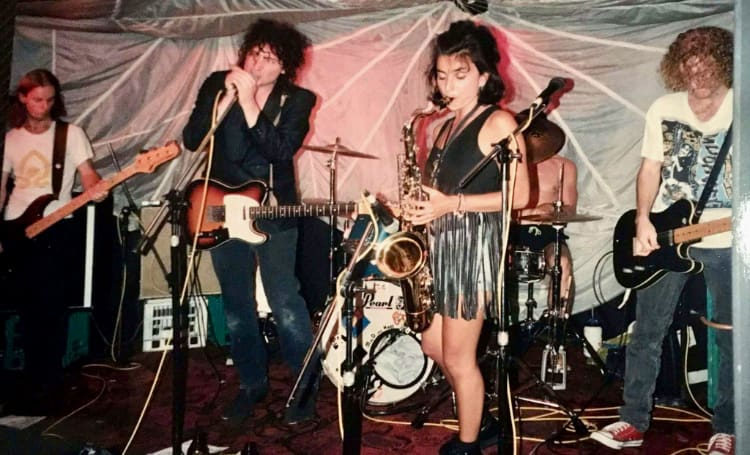
 Waxworks at The Punters Club in Melbourne in 1991. Peter Kelly on bass, Edwin Garland on guitar and vocals, Goknur Ustandag on sax and Murray Bown on guitar. Drummer Simon Gibson is obscured, Artist supplied.
If you’re a regular Barfly, Edwin Garland will be a familiar name. A longtime writer at the I-94 Bar, he chronicles releases and gigs as they take his fancy, and is a confirmed Bob Dylan and Midnight Oil tragic. What may be less obvious is that he grew up in the Sydney underground scene’s halcyon days of the 1980s, as both a participant and observer.
Ed led a band called Waxworks from 1987-92 and they played an intrguing mix of post-punk blues squawl, incorporating sax, as much influenced by art rock as back to basics acts like The Gun Club.
Waxworks were a commercial blip on the Sydney scene, garnering more airplay in Melbourne and the USA than in their hometown. Edwin eventually moved on to a new harder-edged band, Dwarfthrower, but not before his immersion in the Surry Hills scene had garnered a compilation album, made in tribute to one of its most important venues, the Hopetourn Hotel.
Which brings us full circle.
In case you haven’t noticed, there’s a posthumous album “Waxworks 1987 to 1992" out now on Vi-Nil Records and there was a recent sold-out Hopetoun Hotel reunion show in Sydney, co-presented by Edwin and The I-94 Bar.
There’s also a video single on YouTube, “Junkie For Your Love”, from Edwin and Cathy Green, former member of X, Hell To Pay, Ian Rilen & The Love Addicts and numerous others whose current band, the superb Shiver of Destiny, was part of the Hoey reunion gig.
All of which seemed to be a good excuse to unleash our writer-at-large, Cordwainer Bird, to interrogate Ed. Here’s the result.
I-94 Bar: Ed, you’re a compulsive creative and always have many things happening, what are you currently working on?
Ed Garland: Honestly, I feel that word “compulsive” is really inaccurate. Nothing I do is “compulsive”. Sometimes it’s a decade of work behind my projects. It might be the way you work? (laughter) but it’s not for me. The way I create, or work, I look at it at as chipping away. What I do involves discipline and actually spending time, hours per week developing my skills as a writer, songwriter and a musician.
I-94 Bar: So, you see prose writing as the same space as songwriting when creating?
Ed Garland: Songwriting is more spontaneous; that is a better word, honestly. It's like grabbing songs from the sky, as Woody Guthrie said. I have been writing songs for four decades. There is intuition involved, mainly, and lots of words.
With writing prose, I dislike that first draft nonsense and stream of conscious is crap - it’s that underground, first year of Sydney Uni , 1970s talk. Literature is a case in point. Kerouac’s "On the Road" was not actually written in two weeks. First draft, maybe, but it is a myth. There were so many re-writes after that. It was so heavilly re-worked.
For me, great art actually is achieved from hard work in 99 percent of cases. It comes from writing and rewriting - and as a musician, practicing and ever improving. And I am always working on my songwriting and improving my phrasing.
I-94 Bar: Can you tell me more about the prose writing side of yourself?
Ed Garland: That’s something I wish I could devote more attention to. I did, for a decade or so. I have a novel completed. Set in 1823, colonial Australia. That represented years of research and spending time on sites. Even learning an Indigenous language - or rather, an understanding of it. The book will be released in a year or so, and those who have read it love my lush imagery. But it required many re-writes. Getting it right.
I have a few books on the boil - even have a publisher interested. That’s a five-year plan, maybe 10. (Laughter)
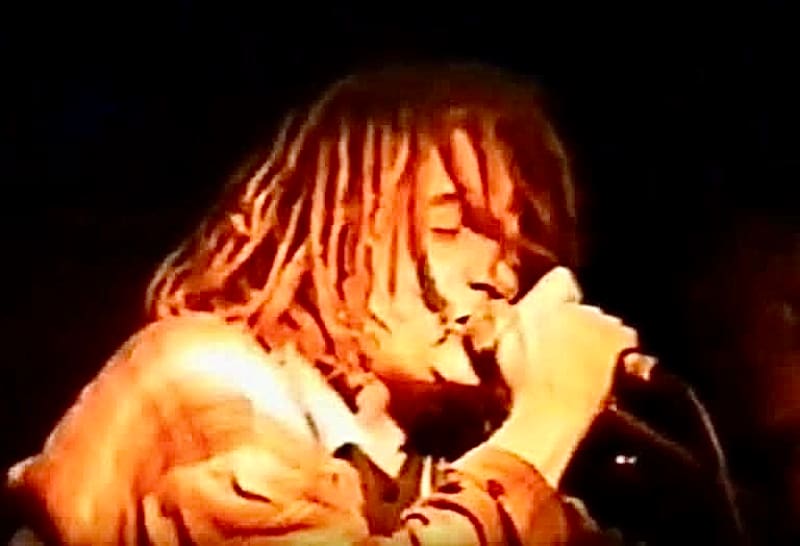 Dreadlock Days: Ed Garland on stage at the Annandale in 1991. Artist supplied.
I-94 Bar: You've been at this a long time.
Ed Garland: Yes, around 2002, I published a national literary magazine with a mate, Harold Malley. A magazine that was in about 300 newsagencies - that was with the late Ross Renwick of the Billy Blue design college. He was a legendary famous surfer and an iconic figure in Sydney. An internationally award-winning designer.
Ross discovered and published many writers - including Peter Carey. Ross sold eight truckloads of books in many countries. He really encouraged me to write and claimed I had this great term of phrase. He wanted to meet me after reading a short story. He claimed my writing style reminded me of E.M Forster.
Ross was amazing and even hung out with Bob Dylan in Paris - they used to have ice cream for breakfast. The same thing happened with Marin Sharp after he read one of my short stories. He rang me because he wanted to talk to me about it - I even had fan letters.
The magazine had contributions by Tom Keneally, Bob Ellis and Richard Neville of "Oz Magazine". I have written many, many short stories. There will be a collection one day.
That said, writing could be a detour - who knows? I love songwriting and more importantly as a discipline. It’s a craft. With online music writing, as it develops so does the need to get to the facts and keep to the point in a record review or live gigs report of 800 words. I have said; "No room for waffle". That (economy) Bukowski had, I admire. For me, writing is communication; like sound, music with words, and aiming that people will read it in one go. I aim my writing to be a page-turner. That’s great writing: not boring the reader.
I-94 Bar: You published Tom Keneally?
Ed Garland: Well, it was such a long time ago, and he was one of the people who supported the mag. He wrote the most beautiful story on Schindler – the Jewish man he met in NYC, and how that story unfolded. I was very honoured that Tom wrote that background to "Schindler’s List" for us. He is really one of Australia’s most talented, intellectually stimulating, knockabout blokes, simply an amazing man, and witty. He’s someone I admire.
Some other projects I'm involved with involve music,. I have just come back from Moonlight Five's first rehearsal. After these few years, we have put together a live band with John Cobbin, who I started the project with at the height of the Covid lockdown. Our song, “Lockdown Blues” (and video with Digby Richards, who played keyboards) went viral all those years ago, particularly in the UK were thousands watched it on YouTube.
The same with the follow-up songs, "Listening To Gospel Music on the Radio" and "I Just Want To Be Me". So we'll finally be playing live.
John Cobbin of Moonlight Studios is on guitar - he's producer of Tamam Shud, Swansea Hit and Run. He played in many top-shelf band on Sydney’s Northern Beaches from the mid-’70s onward. John is a brilliant producer and engineer. Digby Richards is on keys, Jim O'Sullivan is on drums, and I recruited a friend of decades in Rod Thompson. It’s a more street-level, tougher rock version than in the studio, yet still has that loose, just-hanging darker blues, swamp. There’s even some Tom Waits mixed with the wild garage edge of the Stooges.
And certainly, we will bring different musicians in eventually - our friends - and they will always be playing on the album. Moonlight Five will be recording next year, working towards an album. We want the band to remain raw, organic and certainly open to other instruments and percussion. I really love Gypsy Jazz - a moment that might be a bridge bit too, playing Django Reinhardt, but the old French suits would be cool to wear. (Laughs).
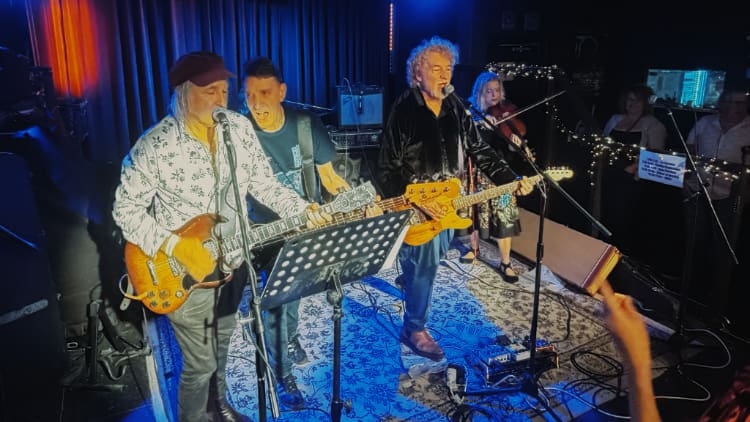 Onstage with The Hoey Barflies. Murray Bennett photo.
I-94 Bar: Moonlight Five isn't the only band you're in, though.
Ed Garland: Well, the other Sydney project is The Hoey Barflies, which is Jeffery Wegener of The Saints, Laughing Clowns and Young Charlatans, and the wonderful Susie Evans (Box of Jesuit) on violin, and Ben Aylward from Swirl and Fabels.
It’s wonderful to be in a band with Ben particularly who is very gifted. Swirl were an amazing band and were even a huge college band in the USA, and toured there a lot. Steve Clark of Died Pretty is onboard as well.
We are playing songs by Waxworks, Swirl and Box of Jesuit from around 1991, revisiting songs from our back catalogues of decades ago. Most importantly, I love those guys. Great mates, and feels like a gang. Susie Evans and myself are really great pals and have and she just has a wonderfully clear way of seeing things.
Jeffrey is a man of incredible culture, and with a few Scotchs under his belt, he enjoys reciting poetry - loudly, T.S. Elliot. And he has an incredible knowledge of the history of jazz and where all the shuffles came from.
We might record a live album and occasionally playing a gig on rare occasions A Melbourne tour might happen. It's only one gig at a time. (ED: The only show so far was at The Spirits of the Hopetoun show in Sydney in November.)
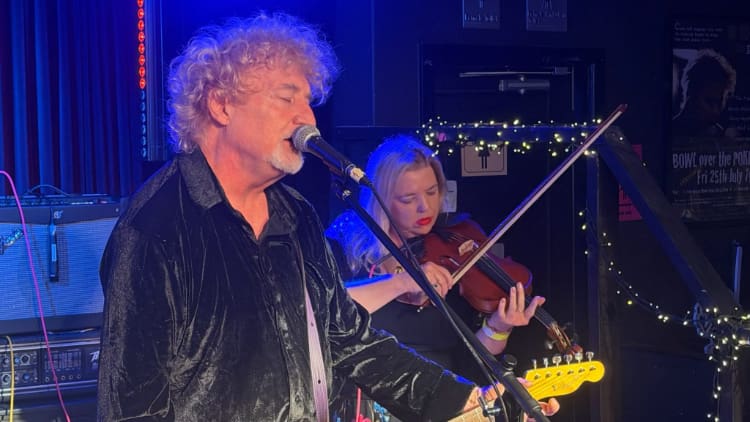 Hoey Barflies: Ed with Suzy. Murray Bennett photo.
I-94 Bar: You were in Melbourne a couple times this year, what did you get up to?
Ed Garland: Melbourne and I always seem get along well. Particularly with airplay. I love playing there. And of course, Cathy Green lives near there. I adore Cathy. We recorded and Boris Falovic of her band aShiver of Destiny dded some guitar. Cath has been a friend for decades, and as a person and artist she represents a beautiful mix of soul and swagger.
We intend recording our songs and an album. It will have rustic and sensitive songs that started with acoustic guitar...songs that no-one's heard over the years. Cathy has some beautiful songs and we bring them all to the table. We both love Dylan, in particular his "Time Out of Mind" and "Oh, Mercy" period; we're also Tom Waits fans, and love really old Delta blues and country.
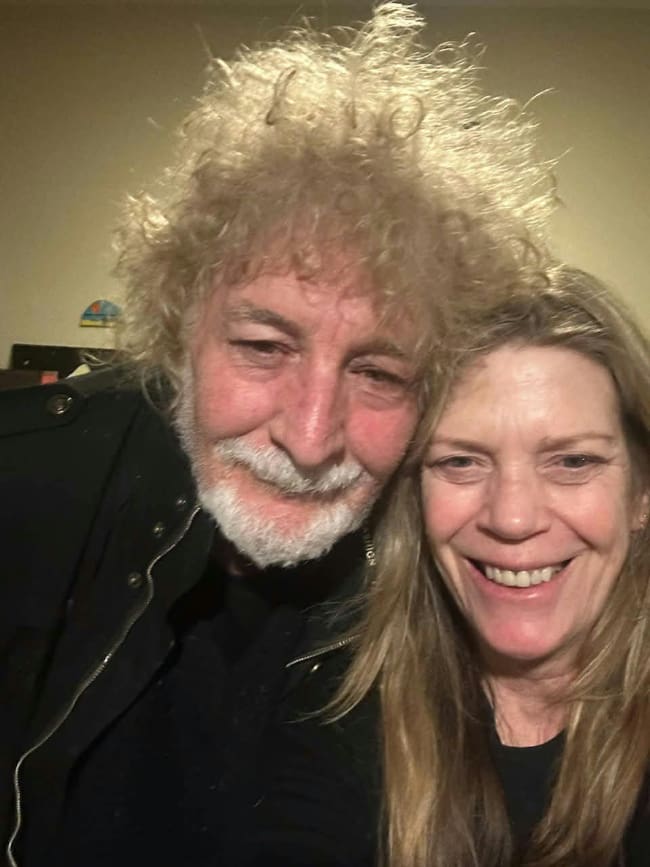 Edwin and Cathy Green.
Working with Cathy is calming and we are on the same page. A special page made of soulful textures.
(Producer and engineer) Mike Stavrou's also involved; he's been a close friend of mine for well over three decades. He was George Martin's understudy at AIR studios London; I joke with Mike he has responsible for selling 100 million records. He has. And won Grammys and the English version of that award for work with Paul McCartney, He might even have an Oscar for a soundtrack, but don’t quote me.
Stav is one of the legendary mixing engineers of the 1970s and 1980s. When he lived in Sydney, even Bowie wanted to record an album hwith him. He pulls such naturally pure sounds: he is the sound engineer that sound engineers look up to. His book, "Mixing with Your Mind" [Flux Research, 2003] is internationally regarded as an industry standard, a bible in sound.
Michael knows how get the most amazing sounds with one microphone and mix; I think today of the hours we have worked together - not only with my music but also with the bands I produced in the 1990s. It must be hundreds of hours. (ED: He mixed and mastered the recent Waxworks LP.)
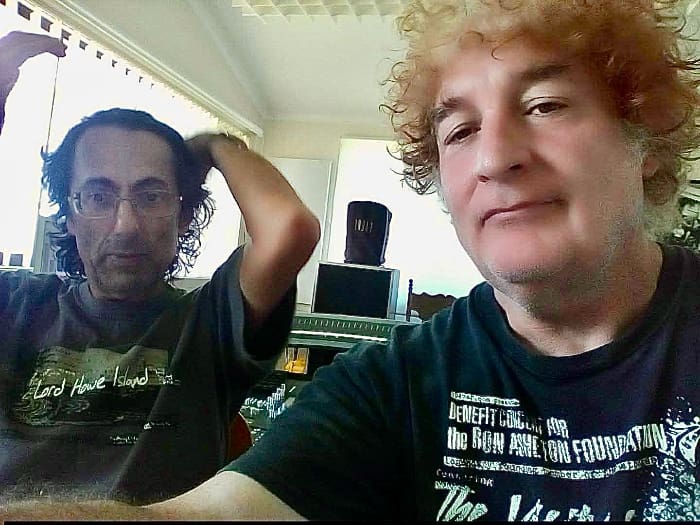 Edwin working on the Waxworks mixes with Mike Stavrou.
I-94 Bar: You were involved with Ernie O’s project, "The Institutionalist". Talk about that.
Ed Garland: Yeah, Ernie is just someone I connected with in a matter of minutes, - it was like we were mates from school and had been friends for a lifetime. He does not suffer fools and will not work with those he feels are all ego and no substance. As far as engineers go, he is so up there, cutting edge and creative. He asked me to collaborate with the song and video of "Ward of the State" and it's received great airplay on community stations.
I recently had a song called “Gone Amok” which I wrote for the album, and Ernie just made it glow. As a co-writer, Ernie's production weaved his magic. It's edgy and has an amazing feel of 1980 post-punk. I'm looking forward to the video and final mix which will come out next year.
I-94 Bar: There's a Waxworks retrospective, "Waxworks 1987 to 1992" out on vinyl on Vi-Nil Records. (ED: Reviewed here and available here.) Talk about it.
Ed Garland: I was thinking about this the other day; it's been actually 30 years in the making. It is weird - I was talking about putting out a retrospective with (latter day label head) Sebastian Chase when my band was on Phantom Records in late 1990s. He’d heard our last recordings and dug them. A decade passed and I found all these DAT tapes of the sessions, and we had the original vinyl seven-inch singles.
The DAT tapes had a few audio issues but we fixed them. I had about 20 songs - even a one recorded by a friend, Steve Abrahall, on a Walkman at the North Gong Hotel in Wollongong around 1990. It was labour of love over many months: I also called people and gathered live photos and old handbills.
I-94 Bar: With a compilation like that the sound quality can be all over the place.
Ed Garland: That has lot to do with who masters it. Then it could be pieced together to make it sound like a cohesive album. Sonically, it had to be Mike Stavrou, as he'd recorded and mixed many of the songs. So I went to his his home of Mullumbimby. It was two days of work and quite complex. Well, not for Mike - he is a genius. Originally it was to be on CD, but I never got around to putting it out.
Over the years, interest in Waxworks has grown. The Facebook page has 1100 members. I get overwhelmed that it's up there with pages like The Hummingbirds n terms of followers. It's a bit like where a band that had a tiny cult following has gathered more fans over time. We have more people into the band now - well, in Australia - than at the time it was active. We were a Hopetoun band and were linked to that venue. And the Hopetoun has since been celebrated.
We were pretty much ignored by the industry. Not part of the Triple J mafia or that quite-beige private school, low-fi pop music at the time. Or the hip Sando drinking scene. Yet, we were so critically acclaimed by the street press, and with important music magazines here and overseas.
We were actually played on lots of US college radio stations. Deb Orr from CMJ in NYC really dug us. She took me to the coolest club in the East Village and Nirvana were playing but there was hardly anyone there. Decades later when I was asked to write the obituary for Damien Lovelock for USA magazines like "The Big Take Over", legendary rock writer Jack Rapid told me he remembered Waxworks and really, really liked us. Very flattering.
But more importantly, the members went on to other bands that were really inner city of the 1990s; bands like Disneyfist, Dwarfthower, Aerial Maps, Decoder Ring, Moonlight Five and another 10 off the top of my head. It was the first original inner-city band for all us. We were kids.
The LP has come out this year due in no small part to the wonderful work and vision of graphic designer Murray Bennett who became involved through his work with other inner city bands and books.That involvement was important along with that of Mark Fraser from the Vi-Nil label. I have so much respect for Mark. I felt his label was so street level and in the same spirit of the band from when were around. Mark is another person who is so committed and really keeps our scene alive.
Finally, Dr Greg Ferris from University of Technolgy Sydney, who saw back in the day and wrote such amazing words about The Hopetoun and the band in the “Spirits of The Hopetoun” book.
Waxworks was a band that was pretty unique at the time. Adam Gibson from Aerial Maps, who used come on the Melbourne tours as a teenager, once said to me that we were really before our time. I can hear that now with the guitars and the fact that we had saxophone. A hint of Morphine - we would been more suited to being a band after 1992. Who the fuck knows!! It was so long ago.
Music scenes are fickle at the best of times. But we were influenced by The Saints, Gun Club and artier Sydney sounds of the early 1980s. We had our foot in both camps - like American alternative bands like The Pixies. We certainly were not a Goth band (laughs). The record is a time capsule and a labour of love.
I-94 Bar: Tell us about your involvement with the Hopetoun project and the sold-out Sydey gig.
Ed Garland: A few years ago, I received a request for an interview by Dr Greg Ferris and Dr Liz Giuffre who are both professors at UTS, asking about my involvement with the Hopetoun Hotel and the compilation album I produced with bands who were playing at the venue. They were involved with a research project and a short documentary. They showcased this at an exhibit which included a 3D creation of the venue and was attended by 700 people as part of the Sydney Livid Festival. This evolved into a stunning book.
They interviewed me because I had been part of the Surry Hills music scene in the 1980s and into the 990s. But, more importantly, I had put out a very successful album "Big Hope, Little Toun", that was based on bands that played there around 1991. The album was at the height of the venue's success, and there was an amazing community around the venue. It was the launching pad of so many artists. Like Tex Perkins and Paul Kelly.
The album launch actually broke the bar record. A thousand punters attended the venue in the week of the album gig.
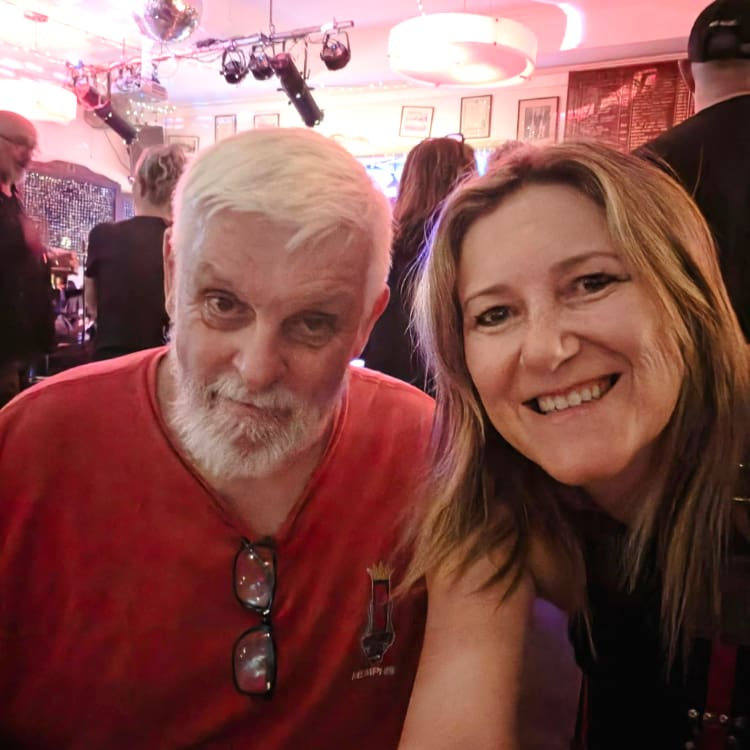 Phorographer Bryan Cook and vlogger Gioia Di Dontao. Gioia Di Donato photo.
It was all do-it-yourself even back then. The book has been so successful because of the archival photos of Bryan Cook. Cookie took tens of thousands of photos of musicians and bands - and more importantly, the audience that was there.
I performed as a solo artist, acoustically, in the late 1990s, or with my band Waxworks earlier in that decade. Yeah, the Spirits of the Hopetoun gig - I proposed it to Craig Barman, and putting it together was intense process with multiple date changes and various people overseas. There were 18 musicians involved. It sold out in five weeks with almost no promotion. Just word of mouth like the old days.
I-94 Bar: Can you tell us a little more about Bryan Cook?
Ed Garland: Bryan is a mate, and they broke the mould when they created him; a photographer and archivist. He is a Kiwi and was in the UK for the punk explosion from 1977. When he landed in Australia in the 1980s, he felt he had already seen all the bands he needed to. But the scene in Sydney was so good that he bought a camera and took thousands of snaps.
In fact, he went on to take 40,000 photos while he was out seeing bands. He shot them, audiences and bar staff around Surry Hills at least three nights a week. Many of the gigs he shot were mine. The Powerhouse Museum has purchased about 1000 of them - including photos of me at The Hopetoun. Which is amazing.
Anyway, I was having beers with Cookie and my best mate Nick Bleszynski at the Hollywood Hotel in Sydney. It was the first time Nick had heard Cookie’s story and was stunned that there not been any sort of doco on Cookie. Nick is an award-winning producer and filmmaker and author; he's made films with the History Channel, SBS and BBC. Maybe made over 30 films and worked on 20-odd broadcasters across the world. He always feels that we don’t really celebrate our underground figures, especially away from the mainstream.
I-94 Bar: Tell me more about the doco.
Ed Garland: Yes, I wrote a script with Nick's guidance. We brought in Gioia Di Donato, who has made these DIY street level vlogs on venues and the Australian music scene with a huge online following, We had her brother Roberto editing. We did some intense shooting. It was hugely popular. Our YouTube doco went on to be watched by by almost 7000 people.
The Hopetoun ran from 1983 to around 2009 and thousands of bands played, with such names as Paul Kelly, Archie Roach, Celibate Rifles, Ian Rilen, Chad Morgan, Tex Perkins, Ed Kuepper, Box The Jesuit, Swirl, Tim Rogers, Sarah Blasko, The Clouds, Cathy Green and X.
I-94 Bar: What's your current stage rig? Favourite instrument? Favourite pedal/s?
Ed Garland: I am incredibly into guitars. I love working in the studio and have produced a number of bands. I would have summarised with two sounds that use with my projects: firstly tape echoes with single coil pickups, particular the back pick of a Telecaster, and lipstick pickups - really I was fascinated with that sound since I heard "Time Out of Mind" by Bob Dylan, and traced it back with Daniel Lanois.
I love my 1948 vintage arch-top Gibson - the same sort model that Cliff Montgomery, or Charlie Christian uses. The limitations of the 1940s and 1950s technology: and records were so perfect and full of atmosphere.
I-94 Bar: "Ward of the State" with Ernie - that's much heavier and sonic.
I-94 Bar: True, I have a flipside; a brutal sound and I know how to get it. I have not to even more primal and brutal. The guitar is most amazing instrument. The range. I have aimed for a guitar sound that is raw. That was the sound of my other band Dwarfthrower.
I think it's best summed up by the fact I am on Stav's sound industry tape of artists he's engineered. As I mentioned, Mike is a world-regarded great engineer. Of the thousands of artists he has produced or engineered over the years, I am in the 20 he chose for his industry tape. There’s the London Symphony Orchestra, Souixsie and the Banshees, Kate Bush, The Pretenders, Bowie, Paul McCartney and then Classical and Spanish guitar of John Williamson - and then there is two minutes of my brutal primal sound (laughter).
Mike said in five decades he never heard anyone play like I do and I play hard with heavy, nasty with heavy gauge strings and the way I flick the strings. Maybe like Ron Asheton at his rawest meeting Ian Rilen. It was simply me and a Marshall Stack and a pre-amp pedal. A cheaper Gibson Sonex, made from resin and wax, stood in front and feeding back as I played.
To sum it up - and I like to flip, depending my mood, the song and who I am playing with - I'm trying for sounds that come from the swamp and 1950s blues, with analogue tape echoes of '60s Eccolettes and surf sounds. With a band, I aim for the most primal rock sound - like feedtime.
I-94 Bar: Could you tell me your top five gigs, and what makes a great gig?
Ed Garland: Are you running out of questions? I think we've covered all the ground. It’s now a teen pop magazine from the 1960s and you’re interviewing The Monkees (laughter).
I was fortunate to see Midnight Oil in an over-packed Royal Antler, Hotel and nothing compared. The Birthday Party and X and The Scientists at The Roundhouse, or The Clash, or Tom Waits in Milan, or Patti Smith, Bob Dylan. Nirvana in a small club in NYC, or maybe, Ramblin' Jack Elliot in a tiny bar in Katoomba with only 20 people there. And he represented the history of US folk music and actually taught Bob Dylan that there are no formulas . Whatever raises the hairs, and has soul. So, I won’t try a Top Five.
This year for me, seeing Wet Leg left a mark. Then we have local acts like Full Flower Moon Band or Grace Cummings who are so explosive and committed.
On the world stage, I am constantly watching Sofia Isella on her YouTube channel and am spellbound by the intensity. I hope she tours. So. original, intense, and performances are more like razor blades then any punk band I have seen, political, and channelling a voice with feminism and how messed up the world is. Here she is, 21-years-old and I am in awe that an artist could be breaking such new ground and talent that you can’t even comprehend.